
01
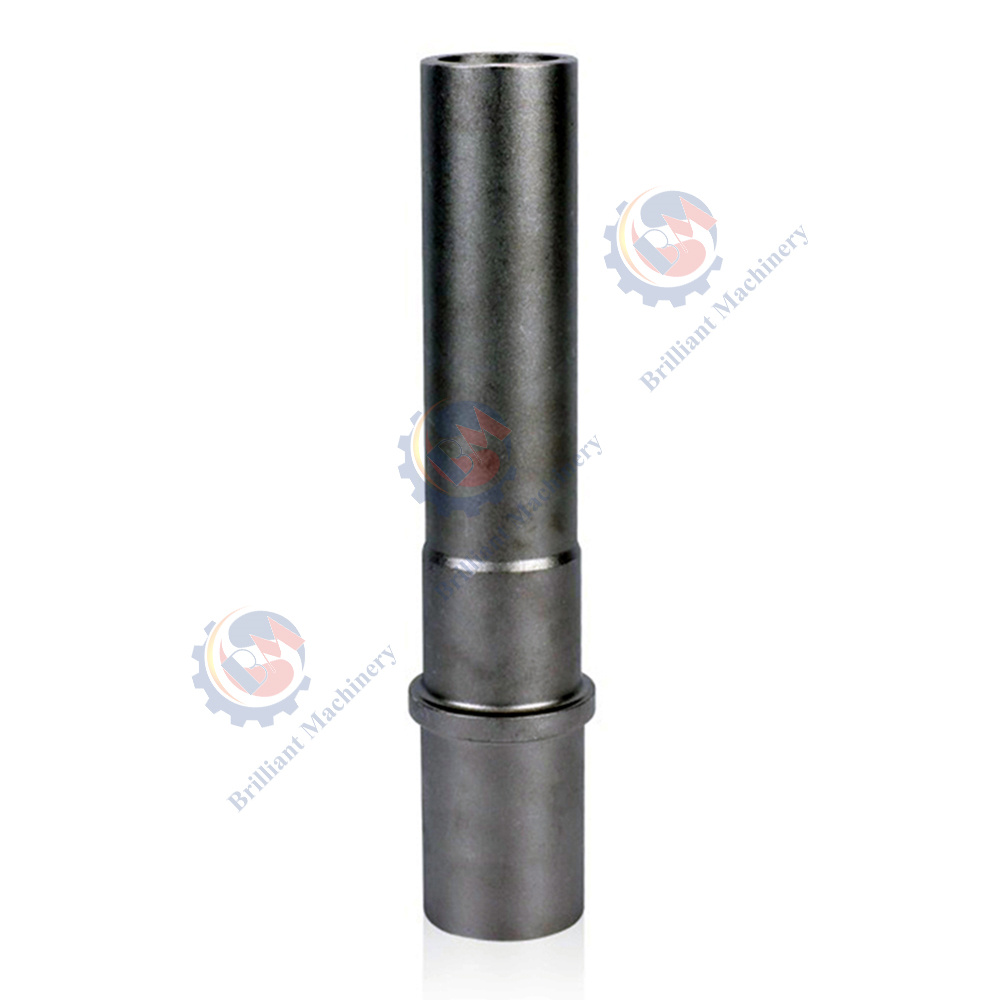
Cold-forged or Cold-extruded Spline Shaft
Material
The material of spline shaft is critical for its operation. Spline shaft materials of widespread usage include:
• Alloy Steel: Often chosen for its excellent balance of weight-to-strength, alloy steel is resilient and hard.
• Carbon Steel: Inexpensive, carbon steel is a cost-friendly material which provides moderate strength and is widely used for everyday usage.
• Stainless Steel: Being resistant to corrosion, stainless steel spline shafts can be ideal for severe environments.
• High-carbon steel: Mostly used in severe usage in which greater hardness and fatigue resistances must be developed.
Specifications
• Material: Alloy steel, carbon steel, stainless steel, carbon steel.
• Length: Customized in size for a specific application, between 50mm and 500mm.
• Outer Diameter: This can be between 15mm and 120mm based on usage.
• Spline Profile and Dimensioning: Can be developed for various spline size and shape, for example, straight-sided, involute, et al.
• Tolerances: Tight tolerance is maintained for assuring other component compatibility and durability.
Production Processes
The manufacturing of cold-extrude or cold-forge spline shaft is a highly regulated process of steps:
1. Cold Forging: The material is first shaped under room temperature and under pressure. This is a process which improves the strength of the shaft by improving its mechanical properties, refining its grain structure, and maintaining dimensional tolerance.
2. Cold Extrusion: In this process, material is pushed under a die in an effort to shape the shaft, which produces highly polished pieces and minimal waste.
3. Spline Forming: The splines, when shape is attained, can be formed via precision tooling or roll process for desired profile and alignment.
Quality Test and Inspection
Every spline shaft is rigorously inspected for its quality so it can deliver maximum output and longevity:
• Dimensional Checks: The shaft is inspected for its exact diameter, length, and spline profile.
• Surface Integrity Test: The shaft is examined for its surface flaws, such as cracks, burrs, or irregularities, for its quality determination.
• Hardness Testing: The material is harden-checked in order to ensure it achieves the necessary strength and abrasiveness requirements.
• Fatigue Testing: In severe stress-bearing environments, for shafts, fatigue testing is being conducted for simulation of lengthy operation.
Key Features
• Enhanced Strength: The cold forming and cold forging enhance mechanical properties of shafting, which provide improved durability and greater strength.
• Precision Fit: Intentional splines forming allows for an ideal mating of mating pieces, which gives a uniform torque transfer.
• Corrosion Resistance: Rusting and corrosion of the shaft is protected against by materials such as stainless steel, which prolongs its lifespan.
• Efficiency in Manufacturing: The cold-forming process is an environmental-friendly process since it prevents material wasting and cutting down on power.
• Durability: The great durability, great tolerance, and abrasiveness of it give it a lengthy lifespan despite adverse environmental factors.
Industry Applications
Cold-forged or cold-extruded spline shafts have applicability in a wide variety of industries, which range from
• Automotive: These shafts have universal applicability in powertrains, axles, and gears, for producing a constant torque output.
• Aerospace: Used in safety-critical systems such as actuation systems and landing gears, which have dual requirements of reliability and strength.
• Industrial Machinery: Applied in big machinery, conveyors, and gearboxes wherein durability is given greater preference compared to precision.
• Agricultural Equipment: Spline shafts on combines, tractors, and other farm machinery operate in extreme environments, necessitating a high-wear-resistant spline shaft.
Packaging and Storage
Spline shafts undergo careful packaging in a way so as not to sustain any sort of damage when being shipped. The packaging may consist of protective wrapping, a foam insert, or a wooden case in the thought of avoiding flexing or scratching. The shaft is stocked in a controlled, dry place, away from dampness and extreme temperature.
Shipment
Depending on the location of delivery and quantity of order, spline shafts can be shipped by sea, ground, or aircraft. Each is carefully packed and followed for secure and timely delivery so perfect-quality parts can reach the customer.